The purpose of this decision support tool is to provide initial screening for remediation options for an individual source-pathway-receptor linkage (also known as a contaminant or pollutant linkage). A linkage may apply across an entire contaminated site or a zone of a site. More than one linkage may be present in a particular area. The tool allows you to screen multiple linkages, based on information that you provide.
We will retain this information in confidence in the cloud so that you can
review your linkages multiple times and update the information provided, or
use the tool to support meetings with different stakeholders (e.g. site owners, regulators etc).
You can (if you have purchased credits) output screening reports at any stage.
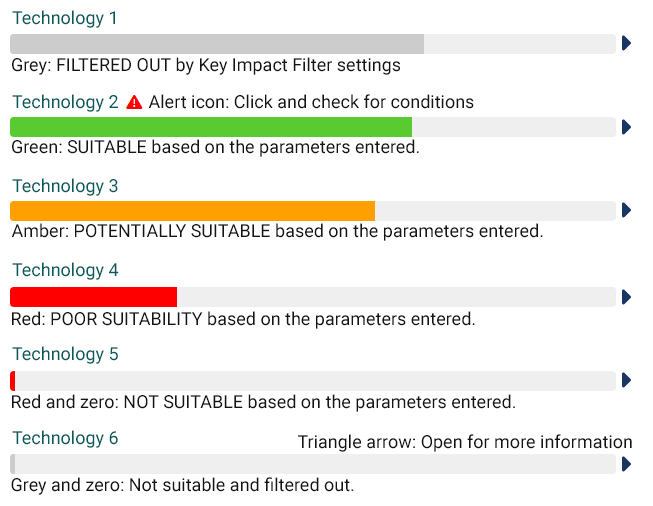
Please check the figure right to understand the colours and symbols in the DST.
Report Owner
New Site Information
Retrieve Site Information
Decision Support Tool
The Decision Support Tool is a screening tool. Not all contaminants have been included. Additional contaminant rules will be added over time. If you have a suggestion, please provide feedback. Our Enquiry Panel is available to support you on more detailed site specific questions following your screening.
Input Parameters
You can use these drop downs and the sliders to input information for your contaminant linkage. You can deselect sliders if you do not have information or consider them irrelevant. Alternatively you can use the qualitative descriptors if you do not have quantitative information, for example at an early site assessment stage. The greater the range of input information the more reliable the screening will be.
Air sparging involves injecting air into contaminated groundwater to volatilize and remove contaminants, while biosparging enhances biodegradation by supplying oxygen to microorganisms.
Targeted problems
Source and pathway management for:
Petroleum hydrocarbons
Chlorinated solvents
VOCs
Organic contaminants
Performance gains
Accelerates degradation of contaminants
Increases removal efficiency of VOCs
Low-cost compared to traditional excavation
Effective for both dissolved and adsorbed contaminants
Bioelectrochemical Remediation
▶
Bioelectrochemical Remediation (BER)
Bioelectrochemical enhanced degradation of reduced and oxidized compounds. Enhanced redox through electrode participation in microbial metabolism of environmental pollution.
Targeted problems
Source and pathway management for:
Petroleum hydrocarbons
Chlorinated solvents
Heavy metals
Performance gains
Petroleum hydrocarbons
Chlorinated solvents
Heavy metals
Long term solution over an operational site's lifetime
Cheap: simple installation, and maintenance, and zero / low energy demand
Tolerates high contaminant concentrations
Treats mixed contamination
Capping and cover systems
▶
Capping and cover systems
Capping and cover systems involve placing an impermeable layer over contaminated materials to isolate them from the environment, preventing exposure and limiting the infiltration of water that could spread contaminants.
Targeted problems
Effective for containing:
Landfill waste
Heavy metals
Organic contaminants
Radionuclides
Performance gains
Cost-effective containment solution
Reduces exposure risk and environmental impact
Minimizes leachate production
Applicable to large contaminated areas
Electro Nanobioremediation
▶
Electro-nanobioremediation (ENB)
In situ bioremediation integrated sequentially or in parallel with nanoscale zero-valent iron (nZVI) applications in combination with electrokinetic inputs
Targeted problems
Source and pathway management for:
Complex and persistent halogenated organic compounds
Pesticides
Metalloids
PFAS
Performance gains
Broader range of treatable aquifers
Reduced resource use (less bio-substrate, ZVI)
Reduced energy demand / renewable energy supply
Tolerance of high contaminant concentrations
Electro-remediation
▶
Electro-remediation
Electro-remediation utilizes electric fields to mobilize and remove contaminants from soil or groundwater. Electrodes are placed into the ground, creating an electric field that drives contaminants towards collection points for treatment or removal.
Targeted problems
Effective for:
Heavy metals
Chlorinated solvents
Organic contaminants
Radionuclides
Performance gains
Non-invasive with minimal disruption to the site
Effective in low-permeability soils
Adaptable for use in various subsurface conditions
Potential to enhance biodegradation when combined with other methods
Controlled and precise application of electric fields
Enhanced Phytoremediation
▶
Enhanced Phytoremediation (EPR)
Combination of rhizodegradation with electrokinetic treatments and other interventions. There are multiple synergies: including:
Within the root zone recalcitrant organics can be rendered biolabile,
immobilisation of metalloids in biomass or iron oxides from sacrificial iron electrodes,
improved growth conditions and supply of contaminants,
vertical integration to provide ongoing treatment by redox processes and bio stimulation at depth
Targeted problems
Diffuse source terms and pathway management for:
PAHs and other organics
Chlorinated aliphatics
Metalloids, e.g. arsenic
Performance gains
Long term, low input solution,
Resilience to contaminant toxicity
Large area solution
Use of renewable energy
Applicable to a wide range of soil textures including silts and clays
Applicable in the vadose and saturated zones
Ex situ bioremediation
▶
Ex situ bioremediation
Ex situ bioremediation involves removing contaminated soil and treating it above ground using biological processes to degrade contaminants. This method typically includes techniques such as land farming, composting, and biopiles.
Targeted problems
Suitable for managing:
Petroleum hydrocarbons
Pesticides and herbicides
Organic contaminants
Performance gains
Effective for large volumes of contaminated soil
Contaminants are degraded naturally by microorganisms
Cost-effective and sustainable
Can be accelerated by controlling environmental conditions
Ex situ thermal treatments
▶
Ex situ thermal treatments
Ex situ thermal treatments involve excavating contaminated soil and heating it to volatilize and remove organic contaminants. Methods include incineration, thermal desorption, and pyrolysis.
Targeted problems
Effective for removing:
Volatile organic compounds (VOCs)
Chlorinated solvents
Petroleum hydrocarbons
Performance gains
Can treat high contaminant concentrations
Permanent destruction of many organic contaminants
Rapid treatment compared to biological methods
Effective for a wide range of soil types
Excavation
▶
Excavation
Excavation involves physically removing contaminated soil or material from a site for off-site treatment or disposal. This method is commonly used for smaller areas of contamination or when rapid remediation is required.
Targeted problems
Suitable for removing:
Heavy metals
Petroleum hydrocarbons
Organic contaminants
Performance gains
Immediate removal of contamination
Highly effective for localized contamination
Allows for complete site restoration
Can be combined with off-site treatment technologies
Impermeable barriers
▶
Impermeable barriers
Impermeable barriers are physical structures installed in the subsurface to prevent the flow of contaminated groundwater or to contain contaminants within a specific area. These barriers are often made of materials such as bentonite clay or synthetic liners.
Targeted problems
Used for controlling:
Chlorinated solvents
Petroleum hydrocarbons
Heavy metals
Radionuclides
Performance gains
Effective for preventing contaminant migration
Long-term containment solution
Minimal maintenance once installed
Suitable for groundwater management
In situ bioremediation
▶
In situ bioremediation
In situ bioremediation enhances the natural biological processes that break down contaminants by optimizing conditions for microbial growth, such as adjusting nutrient levels and oxygen availability.
Targeted problems
Source and pathway management for:
Petroleum hydrocarbons
Chlorinated solvents
Heavy metals
Nutrients
Pesticides
Performance gains
Environmentally friendly due to natural degradation
Cost-effective for large-scale sites
Low maintenance once established
Adaptable to diverse contaminants and conditions
In situ chemical oxidation / reduction (ISCO/R)
▶
In situ chemical oxidation / reduction (ISCO/R)
In situ chemical oxidation/reduction (ISCO/R) involves injecting chemical oxidants or reductants into the subsurface to chemically degrade contaminants into less harmful compounds.
Targeted problems
Source and pathway management for:
Petroleum hydrocarbons
Chlorinated solvents
Pesticides
Heavy metals
Performance gains
Rapid reduction of contaminant concentrations
Adaptable to various contaminants
Minimal disturbance to the environment
Cost-effective for complex contamination issues
In situ flushing to change contaminant mobility
▶
In situ flushing to change contaminant mobility
In situ flushing involves the injection of water or other suitable fluids to mobilize and remove contaminants from soil or groundwater. This method aims to enhance the mobility of contaminants, making it easier to extract and treat them.
Targeted problems
Source and pathway management for:
Petroleum hydrocarbons
Chlorinated solvents
Heavy metals
Pesticides
Nutrients
Performance gains
Effective for removing contaminants trapped in soil
Improves extraction efficiency
Minimal disturbance to site infrastructure
Reduces long-term monitoring needs
In situ stabilisation
▶
In situ stabilisation
In situ stabilization involves mixing stabilizing agents with contaminated soil to reduce the mobility and bioavailability of contaminants. This method doesn't remove contaminants but minimizes their environmental impact by immobilizing them.
Targeted problems
Useful for controlling:
Heavy metals
Radionuclides
Organic contaminants
Performance gains
Cost-effective compared to excavation
Minimal site disruption
Reduces leaching and contaminant migration
Long-term containment with minimal maintenance
Versatile in various soil types and conditions
In situ thermal
▶
In situ thermal
In situ thermal remediation involves heating the subsurface to enhance the volatilization, degradation, or extraction of contaminants. Heat is applied through steam injection, electrical resistance heating, or other methods to increase contaminant mobility.
Targeted problems
Effective for treating:
Chlorinated solvents
Petroleum hydrocarbons
Volatile organic compounds (VOCs)
Performance gains
Rapid treatment compared to other methods
Can target difficult contaminants in low-permeability soils
Effective in removing high-concentration contaminant zones
Can be combined with other methods for enhanced effectiveness
Reduces contaminant mass in a short timeframe
Monitored Bioaugmentation
▶
Monitored Bioaugmentation (MBR)
Aerobic TCE/DCE degradation without the need for added substrates, improved dispersion of introduced pollutant degrading bacteria
Targeted problems
Pathway management for:
Chloroethenes
Performance gains
Broadens range of readily treatable aquifers
No substrate needed, so avoids impact on aquifer quality and secondary emissions (CH4 H2S, VC)
Genomics based validation of bioaugmentation
Faster & cheaper (aerobic and reduced complexity)
Monitored Natural AttenuationLIRT
▶
Monitored Natural Attenuation (MNA)
Monitored Natural Attenuation (MNA) refers to the reliance on natural attenuation processes to achieve site-specific remediation objectives within a timeframe that is reasonable compared to other methods. These processes include biodegradation, dispersion, dilution, sorption, volatilisation, and chemical or biological stabilisation, transformation, or destruction of contaminants.
Targeted problems
Source and pathway management for:
Petroleum hydrocarbons
Chlorinated solvents
Heavy metals
Nutrients (e.g., nitrates, phosphates)
Pesticides and herbicides
Radionuclides
Performance gains
Petroleum hydrocarbons
Chlorinated solvents
Heavy metals
Cost-effective due to minimal active intervention
Low disturbance to site ecosystems
Adaptable to a wide range of contaminants and site conditions
Long-term sustainability with minimal maintenance
Reduced risk of exposure to contaminants during treatment
Mycoremediation
▶
Mycoremediation
Mycoremediation employs fungi (particularly white-rot fungi) to degrade, transform, or sequester environmental contaminants. Fungi produce powerful extracellular enzymes that break down complex organic molecules.
Targeted problems
Suitable for addressing:
Petroleum hydrocarbons (diesel, oil)
Polycyclic aromatic hydrocarbons (PAHs)
Pesticides and herbicides
Polychlorinated biphenyls (PCBs)
Heavy metals (biosorption)
Performance gains
Degrades recalcitrant organic compounds
Effective in diverse environmental conditions
Can treat contaminated wood and paper products
Rapid colonisation and treatment
Produces extensive enzyme systems
Complements phytoremediation approaches
Permeable reactive barriers
▶
Permeable reactive barriers
Permeable reactive barriers (PRBs) are installed in the subsurface to intercept and treat contaminated groundwater as it flows through. The barrier contains reactive materials that degrade or immobilize contaminants.
Targeted problems
Effective for treating:
Chlorinated solvents
Heavy metals
Nutrients (e.g., nitrates)
Organic contaminants
Performance gains
Long-term solution with low maintenance
Non-invasive once installed
Cost-effective for passive groundwater treatment
Can target specific contaminants with tailored reactive media
PhytoremediationLIRT
▶
Phytoremediation
Phytoremediation involves using plants to remove, stabilize, or degrade contaminants from soil, water, or air. Certain plants can absorb contaminants through their roots, which are then stored or transformed into less harmful compounds.
Targeted problems
Suitable for addressing:
Heavy metals
Petroleum hydrocarbons
Pesticides and herbicides
Nutrients (e.g., nitrates, phosphates)
Performance gains
Environmentally friendly and sustainable
Low-cost with minimal site disturbance
Improves soil structure and ecosystem health
Suitable for large areas
Potential for landscape restoration
└PhytocontainmentLIRT
▶
Phytocontainment
Phytocontainment uses plants to contain or control the spread of contaminants, preventing their migration through groundwater or soil. Plants act as hydraulic barriers through water uptake, reducing contaminant mobility.
Targeted problems
Suitable for addressing:
Chlorinated solvents in groundwater
Landfill leachate
Agricultural runoff
Contaminated groundwater plumes
Performance gains
Prevents off-site migration of contaminants
Reduces risk to receptors
Lower cost than engineered barriers
Creates vegetated buffer zones
Can be combined with other phytoremediation approaches
└PhytodegradationLIRT
▶
Phytodegradation
Photodegradation can be by direct or indirect processes. Indirect processes can be because of the biostimulation of organisms in the rhizosphere, or direct association between roots and micro-organisms, which are able to biodegrade contaminants.
Direct phytodegradation involves the breakdown of organic contaminants through metabolic processes within plant tissues. Plants produce enzymes (such as dehalogenases and laccases) that transform contaminants into less toxic or non-toxic compounds.
Targeted problems
Suitable for addressing:
Chlorinated solvents (e.g., TCE, PCE)
Explosives (e.g., TNT, RDX)
Herbicides (e.g., atrazine)
Petroleum hydrocarbons (PAHs, BTEX)
Performance gains
Complete mineralisation of some organic compounds
In situ treatment without excavation
Reduces contaminant bioavailability
Can treat both soil and groundwater contaminants
Self-sustaining once established
└PhytoextractionLIRT
▶
Phytoextraction
Phytoextraction uses hyperaccumulator plants to absorb and concentrate contaminants from soil into harvestable plant tissues (shoots and leaves). The contaminated biomass is then removed and disposed of or processed.
Targeted problems
Suitable for addressing:
Heavy metals (cadmium, nickel, zinc, copper)
Metalloids (arsenic, selenium)
Radionuclides (caesium, strontium)
Some organic compounds
Performance gains
Permanent removal of contaminants from site
Applicable to moderately contaminated sites
Potential for biomining (metal recovery)
Improves soil quality over time
Aesthetically acceptable treatment method
└PhytostabilisationLIRT
▶
Phytostabilisation
Phytostabilisation immobilises contaminants in soil through absorption and accumulation in roots, or precipitation within the rhizosphere. This reduces bioavailability and prevents migration without removing contaminants.
Targeted problems
Suitable for addressing:
Heavy metals (lead, chromium, arsenic)
Metalloids in mining areas
Sites with dispersed contamination
Erosion-prone contaminated soils
Performance gains
Rapid risk reduction by limiting exposure
Stabilises soil and prevents erosion
No requirement for biomass disposal
Suitable for highly contaminated sites
Restores vegetation cover to derelict land
└PhytovolatilisationLIRT
▶
Phytovolatilisation
Phytovolatilisation involves the uptake of contaminants by plants and their subsequent release into the atmosphere through transpiration. Contaminants may be converted to less toxic volatile forms before release.
Targeted problems
Suitable for addressing:
Volatile organic compounds (VOCs)
Mercury and selenium (converted to volatile forms)
Chlorinated solvents
Some petroleum products
Performance gains
Removes contaminants from soil and groundwater
Effective for volatile compounds
Natural solar-powered process
Treats groundwater contamination
Minimal infrastructure requirements
└Rhizofiltration (engineered wetlands)LIRT
▶
Rhizofiltration (engineered wetlands)
Rhizofiltration in constructed wetlands involves the creation of engineered systems that use wetland vegetation, soils, and their associated microbial assemblages to remove contaminants from water through adsorption, absorption, and precipitation processes within the rhizosphere. These systems are specifically designed and constructed to utilize natural purification processes for wastewater treatment. See Phytostabilisation and Phytoextraction for further information.
Municipal wastewater, industrial effluent, and stormwater runoff
Excess nutrients (nitrogen and phosphorus)
Performance gains
Can be designed for optimal performance with maximum control over hydraulic and vegetation management
High removal efficiency when optimal species are used
Can be configured as free water surface (FWS) or subsurface flow (SSF) systems with vertical or horizontal flow patterns
Cost-effective and sustainable treatment option with lower operational and maintenance requirements
Pump and treat
▶
Pump and treat
Pump and treat involves extracting contaminated groundwater through wells and treating it at the surface before discharging it back into the environment. This method is commonly used for groundwater remediation.
Targeted problems
Effective for treating:
Chlorinated solvents
Petroleum hydrocarbons
Heavy metals
Performance gains
Proven technology with extensive use in groundwater remediation
Adaptable to various contaminants and site conditions
Can be combined with in situ methods for enhanced results
Continuous treatment option with real-time monitoring
Soil vapour extraction / venting and bioventing
▶
Soil vapour extraction / venting and bioventing
Soil vapour extraction (SVE) involves applying a vacuum to the soil to extract volatile and semi-volatile organic compounds (VOCs and SVOCs) from the subsurface, while bioventing supplies oxygen to enhance biodegradation.
Targeted problems
Source and pathway management for:
Petroleum hydrocarbons
Volatile organic compounds (VOCs)
Chlorinated solvents
Nutrient management
Performance gains
Effective for volatile contaminants
Minimal disturbance to the site
Enhances natural biodegradation
Cost-effective for large sites
Soil washing and related ex situ treatments
▶
Soil washing and related ex situ treatments
Soil washing involves physically separating contaminants from soil particles by scrubbing them in a water-based solution. This method is often combined with other treatments to enhance contaminant removal.
Targeted problems
Applicable for removing:
Heavy metals
Organic contaminants
Petroleum hydrocarbons
Performance gains
Removes contaminants from soil rather than immobilizing them
Can be applied to various soil types
Allows recovery of treated soil for reuse
Reduces the volume of hazardous waste
Solidification / stabilisation
▶
Solidification / stabilisation
Solidification/stabilization involves mixing contaminated soil with binding agents (e.g., cement, lime) to encapsulate contaminants and prevent their migration. It reduces the mobility and bioavailability of contaminants.
Targeted problems
Effective for:
Heavy metals
Organic contaminants
Radionuclides
Performance gains
Long-term containment solution
Cost-effective for large sites
Reduces leaching and contaminant mobility
Minimal maintenance post-treatment
Vitrification
▶
Vitrification
Vitrification involves heating contaminated soil or waste to extremely high temperatures, melting the material and transforming it into a glass-like solid. This method immobilizes contaminants by trapping them in a stable, inert matrix.
Targeted problems
Effective for immobilizing:
Heavy metals
Radionuclides
Asbestos
Performance gains
Permanent immobilization of contaminants
Produces a stable, durable end product
Minimal environmental impact post-treatment
Can be applied to highly hazardous waste
Save Record
Would you like to update the existing record or save as a new record?